
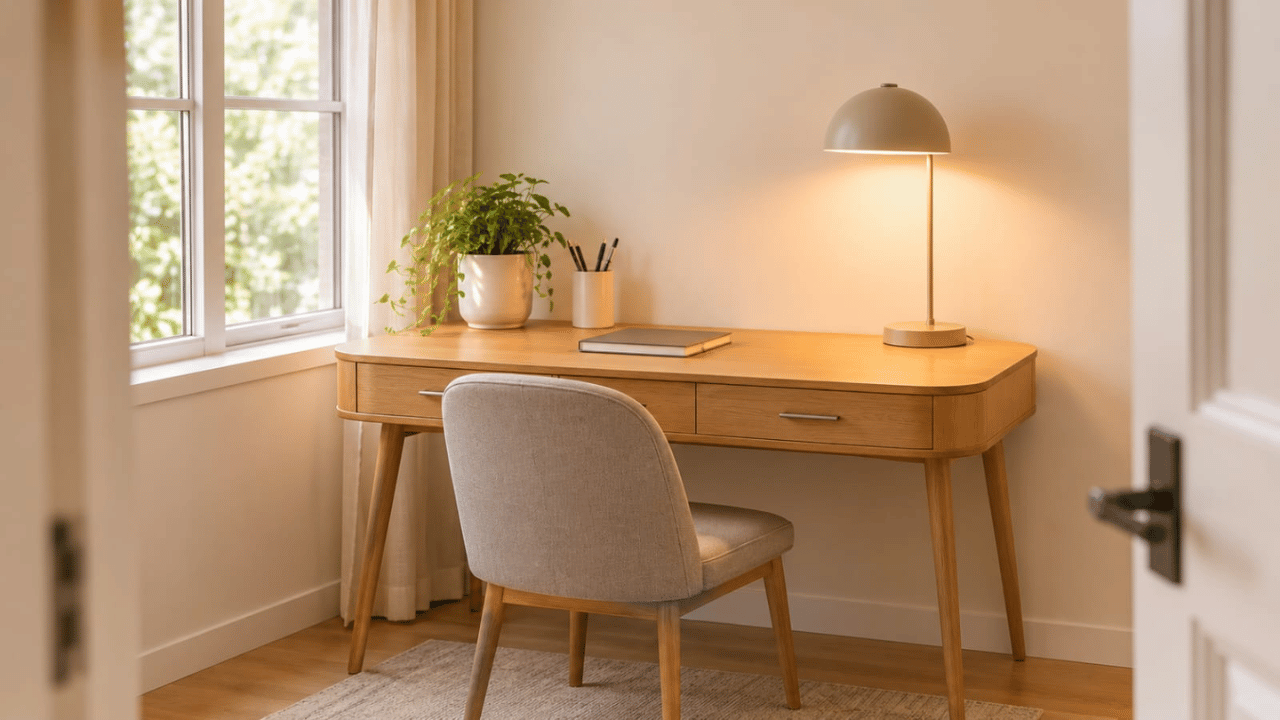
A desk looks different when the camera follows someone into the room instead of facing the furniture against a blank wall. For a proposed AI furniture film, I want an entrance to reveal a compact work corner: a wooden desk beside a window, a chair tucked underneath, and a lamp waiting at the far end. The finished sequence would show how the composition feels as a space, without inventing features that the actual furniture does not have. Read more about affiliate strategies.
The desk would be a real piece photographed with permission, while the room would be an imagined setting. I would choose one product rather than assemble a catalogue in a single clip. Its rounded front edge and narrow drawers would provide the identifying details. The film should keep those details visible as the camera moves from the doorway to the work surface.
I would begin by photographing the desk from the front and from a shallow side angle, with neutral lighting and no objects covering its edges. A third image could show the drawer handles clearly. These pictures would help me describe the same piece throughout the scene. They would not prove dimensions, storage capacity, or durability; those facts belong in verified product information accompanying the video.
Build a room around the reveal
My room sketch would place the window to the left of the desk and the doorway opposite its front corner. A warm patch of light would lead from the entrance toward the chair. I would leave the wall behind the desk mostly bare so that the product silhouette remains readable. A busy gallery wall might make an attractive interior photograph but weaken this particular furniture reveal.
That entrance-to-desk movement is the idea behind my Seedance 3.0 preparation. The linked page describes a creative workflow built around references, connected storytelling, and scene revision, while also stating that the model is not yet officially released. I would develop the shot brief now and use an available tool for any immediate prototype, clearly distinguishing that prototype from a future model release.
The first version of the brief would ask for a slow forward camera movement that finishes at the front corner of the desk. The chair, lamp, and drawers would stay still. I would avoid asking the drawers to open during the same move because that introduces a second action and could imply a mechanism the product does not contain. The camera alone can reveal the shape and arrangement.
Give the reference images different jobs
The front photograph would define the drawer layout, while the angled view would establish depth and the shape of the legs. My room sketch would supply placement rather than product design. I would describe those roles explicitly instead of presenting the images as interchangeable inspiration. A good furniture film needs the actual desk to remain recognizable even when the surrounding room is invented.
In a future Seedance 3.0 project, I would treat the references as guidance to inspect, not as a guarantee that every detail will survive generation. The first draft would be checked at the moment when the camera passes the desk corner. If a leg changes position or a drawer gains an extra handle, I would narrow the camera path and simplify the scene before adding any decorative objects.
A possible revision would move the starting camera closer to the desk. That reduces the amount of unseen space the generation has to invent and keeps the furniture larger in the frame. I would compare the shorter move with the wider entrance shot, looking for the version that best preserves the product’s character. The more ambitious camera path is only useful if it makes the desk easier to understand.
Let light describe the surface
I would plan a soft band of daylight across the top, stopping short of a bright reflection that hides the grain. The camera would end where the rounded edge catches a little more light than the drawers beneath it. This gives the viewer a reason to look at the surface without relying on dramatic spinning or floating effects. The intended mood is a usable work corner, not a showroom spectacle.
Seedance 3.0 is presented through a workflow that separates creative direction from reference materials, and that distinction helps me write this scene. The photographs establish what the desk looks like; the brief explains how I want light to reveal it. I would keep the source color as the target and avoid describing a glossy finish if the real piece is matte.
If the generated prototype makes the wood appear much darker at the end, I would first examine the lighting request. A sudden move from daylight to amber lamp light could cause a distracting change even without a product-shape problem. I would simplify the illumination to one dominant source, then reserve any lamp glow for a separate close shot if the edit needs it.
Choose one useful detail shot
After the main reveal, I would consider a closer shot of the desktop edge beside a closed notebook. The notebook gives a familiar sense of use, but I would not use it as a measurement claim. I would frame the desk edge and a small section of the drawer front so that the second shot clearly belongs to the same piece.
The Seedance 3.0 brief for that detail would preserve the same light direction and furniture color as the wider scene. A slow lateral movement could follow the curved edge, then settle before the cut. If that movement causes the edge to wobble, I would try a nearly static composition. A calm close view can communicate craftsmanship more clearly than a difficult motion that distracts from the subject.
I would assemble the shots in an editor and add the product name only after the camera settles. Exact spelling, dimensions, and availability would come from the seller’s confirmed information. The moving image would remain an illustrative room concept, with real product photographs available beside it. That pairing keeps the creative film useful without asking it to carry facts it cannot establish.
Make the ending feel ready for work
The final frame would hold on the desk, chair, and lamp with a clear area for a short caption. I would try quiet room ambience and a restrained musical phrase, keeping any sound separate from claims about the furniture. There is no reason to add a drawer sound when no drawer moves. The soundtrack should help the viewer settle into the room rather than suggest an action that never occurs.
Before making prototypes, I would review the platform pricing page and the estimate for whichever available model I select. Future Seedance 3.0 availability and settings would need to be checked at release. My immediate production budget would prioritize a stable main reveal and one meaningful revision, leaving higher resolution finishing until the room and product agree across the sequence.
I would finish with a short film that moves from an ordinary entrance to a clearly composed work corner. The test is concrete: the desk still resembles the source photographs, the camera gives its front edge room to register, and the last frame feels calm enough to read. Preparing that sequence now creates a useful production brief for Seedance 3.0 while keeping the actual video work focused on furniture, light, and space.